
EV Infrastructure for Commercial and Industrial Sites Across the Midlands and North West England
EV Infrastructure

MCT Facilities Group provides commercial EV infrastructure for offices, industrial sites, care facilities, and other managed buildings across Birmingham, Nottingham, Manchester, and the surrounding Midlands and North West England. MCT Facilities Group holds NICEIC approved contractor status, and our electrical teams assess existing supply capacity, design the charging infrastructure, install charge points, and provide monitoring and ongoing maintenance, planned alongside the building’s wider electrical needs rather than as a standalone box on the wall.
Key Takeaways
- EV infrastructure covers electrical supply, cabling, charge points, load management, and monitoring, not just the charger itself.
- Planned alongside a building's existing M&E and facilities work, rather than treated as a standalone project.
- Supports automation and digital monitoring where a site wants charging linked to access control or energy dashboards.
- NICEIC approved contractor status covers our electrical installation work, alongside CHAS and Constructionline accreditation.
- Working relationships with organisations including Towerview Care, Roger Bullivant, M Core / LCP UK, and Hortons.
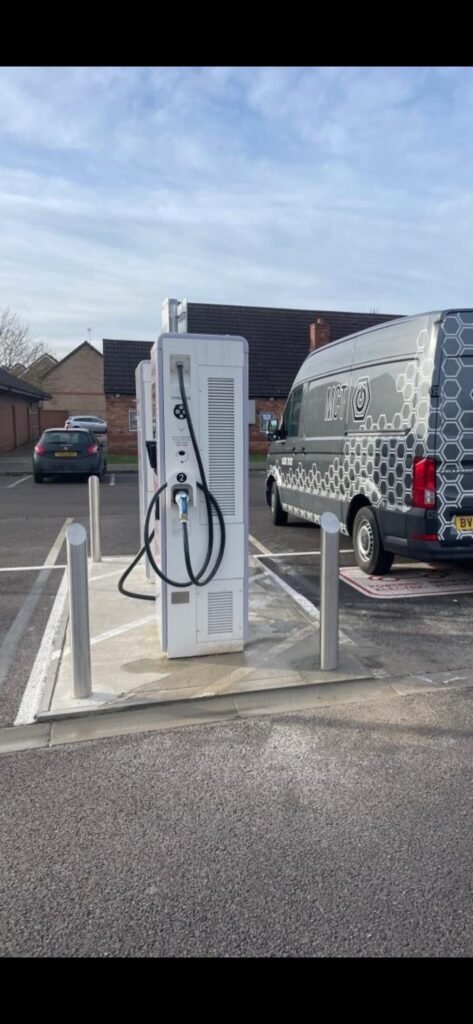
What Is EV Infrastructure?
Get the supply assessment wrong and a site ends up with chargers that can’t run at full speed, or trip the main supply during peak use. EV infrastructure is the electrical capacity to run charging reliably, the cabling to get power to where vehicles park, the charge points themselves, and the monitoring to manage it afterwards.
Because our electrical teams already work on the M&E side of these buildings, we assess EV infrastructure against the site’s existing supply and demand, not as a separate, disconnected system. That’s the real difference between MCT and an EV-only installer: charging gets planned around the building’s electrical reality, not around the charger alone.

AC or DC: Which Suits Your Site?
AC charging tends to suit offices, staff parking, and care facilities, anywhere vehicles are parked for hours rather than minutes. DC charging suits fleets, logistics, and sites needing a fast turnaround, since it delivers power much faster but needs a heavier electrical supply to match. We assess which fits during the site survey rather than defaulting to one option.

How Many Chargers Can a Site Support?
This depends on the existing supply capacity, how much of that capacity the building already uses, the output of each charger, whether chargers will run at the same time, and how much room to grow is needed. Load management, sharing available power across chargers rather than giving each one full power at once, often means more chargers can be installed than the raw supply figures suggest.

How a Project Runs
- Supply and demand assessment. We check incoming supply, distribution boards, existing electrical demand, and cable routes to the parking area.
- Design. We plan charger locations, cabling, load management, and any supply upgrade needed, with room for future expansion.
- Installation. Our own electricians carry out the supply work and charge point installation.
- Commissioning. We test each charge point and confirm it runs at the intended speed.
- Monitoring and maintenance. We set up usage monitoring and schedule ongoing testing.

What We Commonly Find During an EV Site Survey
Supply capacity that hasn’t been properly checked. A site often has headroom for one or two chargers but not the number the client wants, which only becomes clear once the supply is actually assessed.
No load management on multi-charger sites. Several chargers on one supply can overload it at peak times unless power is shared between them from the start.
Cable routes underestimated at the planning stage. The distance and route from the electrical supply to the parking area is often longer or more disruptive than first assumed, which changes both cost and timescale.
No plan for future expansion. Sites installed for today’s demand often can’t be extended later without redoing the supply work, when planning one extra step ahead at the design stage would have avoided it.

What Determines the Cost
Costs increase with electrical supply upgrades where existing capacity is insufficient, long cable routes from the supply to the parking area, groundworks where cabling needs excavation or ducting, DC charging’s heavier electrical requirements, and designing for future expansion rather than today’s number of chargers. We quote after a site and supply assessment, not from a flat rate.
EV Infrastructure by Sector
Offices
longer dwell times generally make AC charging suitable for staff and visitor parking.
Industrial sites
fleet and operational vehicles can add demand on top of existing industrial loads, so this gets planned alongside the site's current electrical use.
Care homes
installation planned around resident and visitor access and uninterrupted site operation. This is the sector our work with Towerview Care sits in.
Retail
charging that works alongside customer parking and peak footfall rather than disrupting it.
Selected Clients and Sectors
Towerview Care
Electrical supply assessment and charge point installation planned around occupied care site access and layout.
Roger Bullivant
Electrical infrastructure work suited to active construction and industrial sites.
M Core / LCP UK
Consistent electrical standards applied across multiple managed commercial sites.
Hortons
EV infrastructure support delivered as part of a wider facilities and M&E relationship.
Where We Provide EV Infrastructure
MCT Facilities Group is based in Burton-on-Trent, with dedicated coverage in the following areas:
| Region | Core City | Surrounding Areas Covered |
|---|---|---|
| West Midlands | Birmingham | Solihull, Coventry, Wolverhampton, Walsall, Dudley |
| East Midlands | Nottingham | Derby, Mansfield, Beeston, Arnold |
| North West England | Manchester | Salford, Stockport, Bolton, Oldham |
Our EV Infrastructure Services
Charge Point Installation. Supply assessment, cabling, and installation of AC and DC charge points, carried out by our NICEIC approved electrical teams.

Automation Systems
EV charging linked to access control, so only authorised users reach designated charge points, and load management that automatically shares available power across active chargers.

Digital Monitoring
Usage and fault monitoring so a client can see how charge points are used and plan future phases from real data.

Modern Technology Innovation
Bringing EV charging together with wider building technology, such as energy monitoring dashboards or building management systems, where a site wants it managed as one system.
What Makes MCT Different
- Supply assessed properly before anything is installed, rather than fitting chargers and hoping the electrics cope.
- Delivered by the same electrical teams behind our M&E work, not a separate EV-only installer.
- Future expansion considered from day one, not bolted on after the chargers are already in.
- Accredited and vetted. MCT Facilities Group holds NICEIC approved contractor status for electrical installation, alongside CHAS and Constructionline accreditation.
Power Your Operations with Reliable EV Infrastructure
End to End EV Infrastructure Support
Automation Systems
Intelligent automation designed to streamline processes and reduce downtime.

Digital Monitoring

Technology & Innovation

Have Questions?
Got a question? Our team is ready to provide the answers and guidance you need.
Monitoring data shows actual usage over time, which is what we use to plan a second phase of chargers rather than guessing at future demand.
Yes. We schedule ongoing testing and servicing, and monitoring helps pick up faults before they become a bigger problem.
Yes. Based in Burton-on-Trent, we provide EV infrastructure across the West Midlands, East Midlands, and North West England, with dedicated coverage in Birmingham, Nottingham, and Manchester.
We plan works around normal site operation, coordinating access and any supply work outside peak hours where possible, so the building keeps running during installation.
Not always. It depends on existing capacity, which we check during the site survey. Some sites can support several chargers on the existing supply with load management alone.
Yes. We design the initial infrastructure with future capacity in mind, so adding chargers later doesn’t mean redoing the original electrical work.
Our Customer Stories

ACCREDIATIONS